The Drift: How Money Influences Judgment
Updated: Mar 7

I remember being a teenager going to baseball games with my dad. He was a physician, and sometimes the tickets came from pharmaceutical reps — and those were the games you didn’t want to miss.
We’d sit in great seats, close enough to hear the crack of Jason Giambi’s bat, or tucked into a luxury box. There was food, drinks, and a kind of polished hospitality that made you feel important. I still remember the elation of being handed a beer by an attractive woman before I was legally allowed to drink. No one seemed to think much of it.
It was just part of the ecosystem.
For years I’ve wondered: do great seats at a game consciously or subconsciously shape prescribing behavior?
I wrestle with that myself now. I’m a financial advisor — and my inbox fills up quickly with emails from product reps. Most doctors would say no. Most advisors would say no. The reps would say the same.
But behavioral psychology suggests the answer might not be so simple.
As humans, we’re wired for reciprocity. When someone gives us something — especially something generous or exclusive — we feel a pull. Not a transaction. Something softer. A subtle tilt of goodwill.
The tickets don’t say: prescribe our drug. The water bottles don't say: use our ETF.
But the experience says: we value you. We see you. We’ll take care of you. You’re part of our circle.
Let me say it again: it doesn’t feel like a transaction.
It lands in the body first. A warmth in the center of the chest. A subtle loosening. Your shoulders drop. Your nervous system shifts from guarded to open. You lean in instead of back.
And here’s the quiet danger: the body wants to return to that warmth.
Long before any conscious decision, your nervous system has already voted.
That residue lingers.
It rarely shows up as corruption. It shows up as preference. As familiarity. As giving one option the benefit of the doubt. It shows up in small interpretive decisions — decisions that feel defensible in isolation.
In the late 1990s, my dad might choose between Merck’s Zocor and Pfizer’s Lipitor. For many patients, it wasn’t a dramatic moral crossroads. It was a low-stakes preference — close enough clinically that habit, samples, familiarity, or even a faint warmth left over from nachos in a skybox could tip the scale.
Similarly, whether I use a Vanguard ETF or a BlackRock ETF is often low-stakes. Both are viable. Both are defensible.
With fancy water bottles.
With leather bags.
With seats near the floor.
You drift.
That’s what unsettles me when I look at power and money in public life. Not because I know what anyone is thinking. Not because I can prove motives. But because — well — we’re human.
When someone receives something life-altering — wealth, status, security — the tie isn’t just financial. It’s existential. It changes their family’s future. Their safety. Their belonging. Their identity.
And when allegations surface around powerful, wealthy people, the question isn’t just legal.
It’s emotional.
And here’s where I need to be honest about myself:
I’m angry.
I’m angry because I think something unfair might be happening. I’m angry because it feels like the ultra-connected may not experience consequences the way ordinary people do. Whether that perception is fully accurate or not, patterns of lenient deals, sealed records, and redactions leave a residue.
It leaves the taste of rotten nachos.
It doesn’t feel symmetrical.
In my Money Is Weird journal, there’s a chart that links feelings to the “money stories” we tell ourselves.
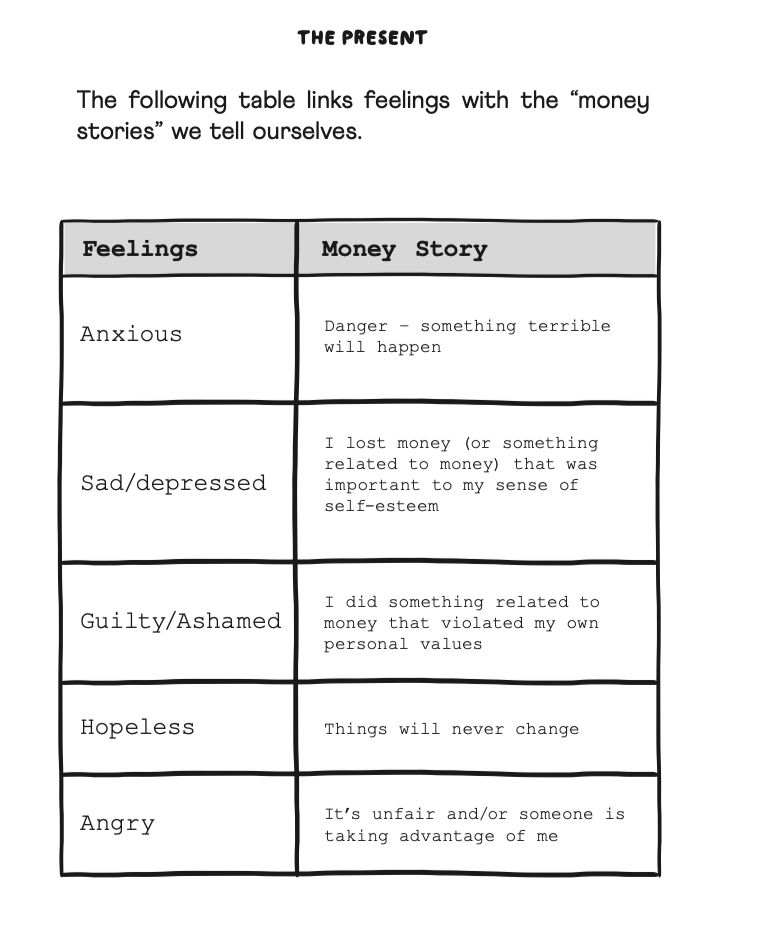
Under Angry, the story reads:
It’s unfair and/or someone is taking advantage of me.
That’s the story running in me.
Humans are exquisitely sensitive to unfairness.
Toddlers protest unequal cookies.
Adults protest unequal justice.
But the chart does something important: it exposes me.
It reminds me that anger isn’t proof. It’s a story. A powerful one. A story that seeks symmetry.
So I have to ask myself:
Is this corruption? Or is this my fairness alarm firing?
Anger wants a villain. Anger wants clarity. Anger wants to close the loop.
But what I’m really wrestling with is something deeper: the possibility that systems — not just individuals — protect themselves. That institutions become more cautious when the stakes are high — and the wealthy make the stakes very high. That risk management and elite networks can overlap in ways that produce unequal outcomes without anyone believing they’re doing something wrong.
If the baseball game isn’t strong enough, here’s a stronger example.
I was 20. I had a girlfriend who was 17. She was blonde. We got caught drinking alcohol by two police officers in the Berkeley Hills. Thank God I was 20 and not 21. But more than my age — thank God I was white. If I were Black or Latino, there’s a real chance that night plays out differently. Maybe that one hillside writes a very different chapter of my life.
That wasn’t a conspiracy.
That was proximity.
What angers me isn’t just a redaction or a name.
It’s the pattern.
It’s the repeated sense that proximity — to wealth, to power, to identity, to the right circles — changes the velocity and visibility of justice.
And if I’m honest, that anger connects back to those baseball games. Because I saw, even as a kid, how influence doesn’t announce itself as influence. It arrives as hospitality. As generosity.
As access.
And damn, that access feels good.
That’s the most dangerous part. Corruption doesn’t feel like corruption while it’s happening. It feels like a relationship. It feels like gratitude. It feels like being seen. It feels like belonging.
And then there’s another feeling from the chart: guilt.
What happens when money pulls you somewhere that doesn’t fully align with your values? When the opportunity looks clean on paper but feels complicated in your conscience?
Guilt doesn’t feel warm. It feels tight. A subtle constriction in the chest. A heaviness behind the sternum. You justify it. You explain it. You rationalize it by pointing to something else good you’ve done.
And yet something in you knows there’s friction.
That’s where the real tension lives.
You don’t wake up compromised.
You drift.
Money is weird.
And the scariest part isn’t the drift.
It’s how normal it can feel.
Q1: What is reciprocity bias in financial decisions?
Reciprocity bias is that quiet mental itch that says, “They did something for me — I should probably do something back,” even when no one asks. In money decisions, it can show up as a doctor leaning toward the drug brand that bought lunch or an advisor favoring the product from the wholesaler who built a relationship. It doesn’t register as influence — it registers as preference, which is exactly why money is weird.
Q2: How does money influence judgment without us realizing it?
Money influences judgment through a gradual drift. Small gestures of generosity, access, and belonging soften boundaries over time — often registering in the body before the mind evaluates them. As warmth and familiarity accumulate, preference starts to feel organic rather than influenced.
Q3: Why does corruption feel normal while it’s happening?
Corruption rarely announces itself as corruption. It arrives as hospitality, generosity, access, and belonging — signals the nervous system reads as warmth, safety, and connection long before the conscious mind runs an ethical audit. That’s why the drift is so dangerous: the feeling of being compromised is almost indistinguishable from the feeling of being valued.
Q4: What is the connection between money and fairness?
Humans are exquisitely sensitive to unfairness — from toddlers protesting unequal cookies to adults protesting unequal justice. When proximity to money and power appears to shape outcomes in legal or institutional systems, it sets off a deep internal fairness alarm. The feeling is powerful — but like all money emotions, it’s crucial to separate the surge of outrage from the underlying facts.
Q5: How do financial advisors handle conflicts of interest?
Financial advisors regularly receive outreach from product representatives offering information, educational events, and industry resources. While professionals strive to remain objective, behavioral research shows that subtle influences like familiarity and reciprocity can shape human judgment in ways that aren’t always obvious. For that reason, ethical advisory practices rely on disclosure, structured processes, and fiduciary standards designed to manage conflicts thoughtfully and transparently.


Comments